
Water Notes Everyday questions
The Water Is Only Half the Story
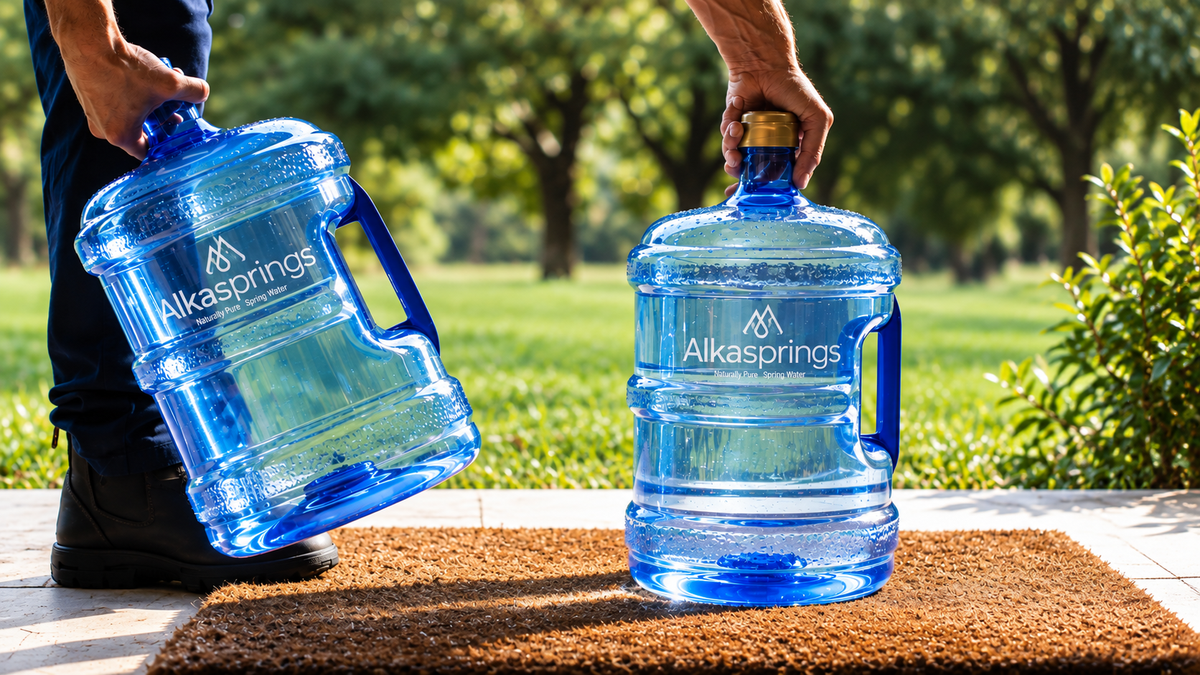
We spend a lot of time talking about where water comes from. Mountains. Springs. Aquifers. Rainfall. Rock.
Those things matter. They shape the water before it ever reaches a bottle.
But once the bottle is filled, another journey begins.
It may pass through warehouses, loading docks, trucks and supermarket shelves. If it comes from overseas, it can travel through ports and across oceans before it reaches Australia. Along the way there is another variable that rarely appears on the label: time.
Then there is the bottle itself.
For years, plastic packaging was mostly treated as an invisible part of bottled water. The important thing was supposed to be what was inside it. Increasingly, research is showing that the container, the temperature it experiences and the way it is handled can also be part of the story.
At Alkasprings, that has reinforced something we already believe.
Looking after good water doesn't stop when you bottle it.
How long is the journey?
Pick up a bottle of water in a supermarket and the label might tell you where it came from.
What it usually can't tell you is everything that happened afterwards.
Some bottled waters are designed to remain on the shelf for a very long time. FIJI Water, for example, states that its water is best consumed within two years of bottling. That doesn't mean every bottle sits around for two years. But it illustrates how long the potential life of packaged water can be. FIJI Water FAQ ↗
For imported water, the journey can also be surprisingly long in distance.
In 2024, Australia imported about 60.8 million litres of unsweetened mineral and aerated water. More than 43 million litres came from Italy, with millions more arriving from France, New Zealand and Fiji. World Bank WITS, 2024 trade data ↗
Think about that for a moment.
Water is heavy. A litre weighs roughly a kilogram. So when bottled water travels from Europe or across the Pacific to Australia, we're moving millions of kilograms of water across enormous distances before it even begins the final trip to the person who will drink it.
Sometimes the journey of the bottle is almost as remarkable as the story on its label.
Ours is deliberately shorter
Alkasprings takes a very different route.
Our spring water is sourced locally from Mount Tamborine. We bottle fresh every day and deliver locally across South East Queensland.
There is no international shipping leg. No need for the water to cross an ocean before it reaches our customers.
And once the water is bottled, we look after how it is stored.
We keep our bottled water in cool, shaded locations and away from direct sunlight while it is in our care. We make the same effort when we deliver it.
If you have a shaded spot at your home or workplace, that's where we'd like to leave your bottles. If there isn't reliable shade, we ask you to leave out a towel so our driver can cover them.
It may sound like a small detail.
We don't think it is.
Because freshness isn't only about when something was bottled.
It's also about what happened to it afterwards.
What happens when bottled water gets hot?
Anyone who has opened a car in an Australian summer knows how quickly heat can build.
That makes storage conditions particularly relevant to bottled water.
Researchers have studied what happens when common single-use PET water bottles are exposed to elevated temperatures. One substance researchers monitor is antimony, which is used during the manufacture of PET.
A study of 66 bottled-water products found that antimony concentrations increased significantly when storage temperatures were raised from 24°C to 50°C. Other studies have also found that migration increases with both higher temperatures and prolonged exposure. Read the study ↗
The point isn't that a bottle exposed to heat instantly becomes dangerous. Under ordinary storage conditions, studies generally find antimony levels below applicable limits.
The more useful finding is simpler:
temperature matters.
And researchers are discovering that it can matter in other ways too.
A 2026 study tested single-use PET water bottles under conditions intended to simulate real-world storage and handling, including heat, shaking and temperature cycling. The combination of high heat and shaking increased the release of nanoplastics by more than nine times in the conditions tested. Water Research, 2026 ↗
Our approach is straightforward.
We don't need to find out how much unnecessary heat bottled water can withstand.
We'd rather keep it out of unnecessary heat in the first place.
Scientists began looking at the plastic itself
Microplastics have changed the way researchers think about bottled water.
In 2022, Australian researchers bought 16 brands of bottled water from the country's two largest supermarkets and analysed them for eight different types of plastic.
Microplastics were detected in 15 of the 16 brands tested.
The most frequently detected plastics included polypropylene and PET, materials commonly associated with bottle packaging and caps. The study also found that the imported bottled waters tested contained, on average, around four times as many microplastics as the Australian-sourced products in the sample. Read the study ↗
The study did not establish that international transport itself caused that difference. Source water, packaging, bottling and storage could all contribute.
But it reinforces a larger point.
The bottle isn't necessarily separate from the water inside it.
Then researchers started seeing what they had been missing
Microplastics are tiny.
Nanoplastics are smaller again.
Until relatively recently, many of these particles were simply too small for researchers to detect easily.
In 2024, scientists used a new laser-based imaging technique to examine bottled water at a much smaller scale. Across three brands tested, they detected an average of roughly 240,000 micro- and nanoplastic particles per litre. About 90% were nanoplastics. NIH, 2024 ↗
That figure shouldn't be treated as a universal number for every bottle of water. It came from three brands and a particular analytical technique.
It did, however, show how much earlier testing may have been unable to see.
Scientists are still working out exactly what long-term exposure to micro- and nanoplastics means for human health. The World Health Organization has identified significant gaps in the evidence and called for more research rather than drawing firm conclusions from the data we have today. World Health Organization ↗
We don't need to turn that uncertainty into a scare story.
The discovery itself is worth paying attention to.
This is why shade matters to us
For Alkasprings, all of this makes something as ordinary as a shaded delivery spot feel more important.
From bottling to delivery, we make an effort to keep our water away from unnecessary heat and direct sunlight.
When we ask customers to nominate a shaded location, we're continuing that process all the way to their door.
And if there isn't shade, the towel isn't just a quirky delivery instruction. It gives our driver a simple way to protect the bottles from direct sun until you bring them inside.
We take that seriously for two reasons.
The first is the water. We want to preserve the quality of freshly bottled spring water throughout its journey to you.
The second is the bottle.
Because ours isn't supposed to have only one journey.
One 15.2 litre bottle. Then another life.
Single-use bottles are designed around a simple sequence.
Fill.
Drink.
Dispose.
Recycling can give some of that material another use, but the original bottle has still completed its job.
Our system starts from a different idea.
Alkasprings water is delivered in 15.2 litre BPA-free returnable bottles designed to come back to us.
One fill carries the same volume as more than 30 standard 500 mL bottles.
When yours is empty, we don't want you to throw it away.
On your next delivery, we collect it.
The bottle returns to our system, where it is properly cleaned and sanitised before being prepared for another fill.
Then it goes back into circulation.
The next 15.2 litres don't require another 30 individual bottles.
The container already exists.
Reuse asks a different question
Australia still has a substantial plastic-waste problem.
In 2023–24, Australians consumed around 4 million tonnes of plastic products and packaging. About 3.2 million tonnes reached the end of their useful life during the year, and only 13% was recycled. Around 87% of plastic leaving the use stage went directly to landfill. DCCEEW, Australian plastics flows and fates ↗
Recycling matters.
But recycling and reuse solve different problems.
Recycling asks:
What should we do with this material now that we've finished with it?
Reuse asks:
Are we actually finished with it yet?
That's the question our returnable bottles are designed around.
An empty Alkasprings bottle isn't rubbish waiting to be dealt with.
It's a bottle waiting to come home.
Taking care of the bottle is part of the system
Returnable packaging only works if the container remains in good condition.
That's another reason we care about where bottles are stored.
We don't want them sitting unnecessarily in full sun. We don't want them baking on hot concrete. We don't want a bottle designed for repeated use being prematurely aged through avoidable exposure.
Keeping the bottles shaded helps us maintain their quality so they can continue doing what they were designed to do.
Come back.
Be cleaned.
Be sanitised.
Be filled again.
Every successful return means the same bottle gets another useful life.
Local water doesn't need an international itinerary
There is something slightly strange about moving water halfway around the planet.
Not because imported water can't be good water.
But because transporting something as heavy as water inevitably adds another stage to its environmental journey.
Australia's 60.8 million litres of mineral and aerated water imports in 2024 included more than 47 million litres from Italy and France alone. World Bank WITS, 2024 trade data ↗
Packaging has to travel with it.
Pallets have to move with it.
The water passes through freight and distribution networks before reaching a supermarket here.
Alkasprings starts much closer to the people drinking it.
Mount Tamborine. Freshly bottled each day. Kept cool and shaded. Delivered locally.
We haven't commissioned a complete lifecycle study comparing our service with every international bottled-water brand, so we're not going to invent a carbon-saving percentage.
We can say something much simpler.
By sourcing and delivering locally, international ocean freight simply isn't part of our water's journey.
And by collecting our bottles for reuse, the packaging journey doesn't have to start from zero every time either.
Fresh means more than a date
For us, freshness is a chain.
It begins at the source.
It continues when the water is bottled each day.
It continues in how we store it.
In keeping it cool and shaded.
In how we transport it.
In where we leave it at your home.
And in asking you to help us keep it protected until you bring it inside.
No single step is particularly complicated.
That's part of the point.
Quality often comes down to taking care of the small things consistently.
The water is only half the story
Of course, the water comes first.
Where it comes from matters.
How it is naturally shaped by Mount Tamborine matters.
How it tastes matters.
But the more you look at bottled water, the clearer it becomes that there is another story wrapped around the water itself.
The bottle matters.
So does how long the journey is.
How the bottle is stored.
Whether it spends time in unnecessary heat and sunlight.
How far it travels.
And what happens when the last glass has been poured.
That's why Alkasprings is bottled fresh daily.
Why we keep it cool and shaded.
Why we deliver locally.
Why we use BPA-free returnable bottles.
Why we'll find the shade at your home, or use the towel you've left for us.
And why, when the bottle is finally empty, we'd like it back.
Because looking after good water isn't just about finding a good source.
It's about looking after it all the way from our source to your glass.
Alkasprings
Real Water. Real Easy.
